
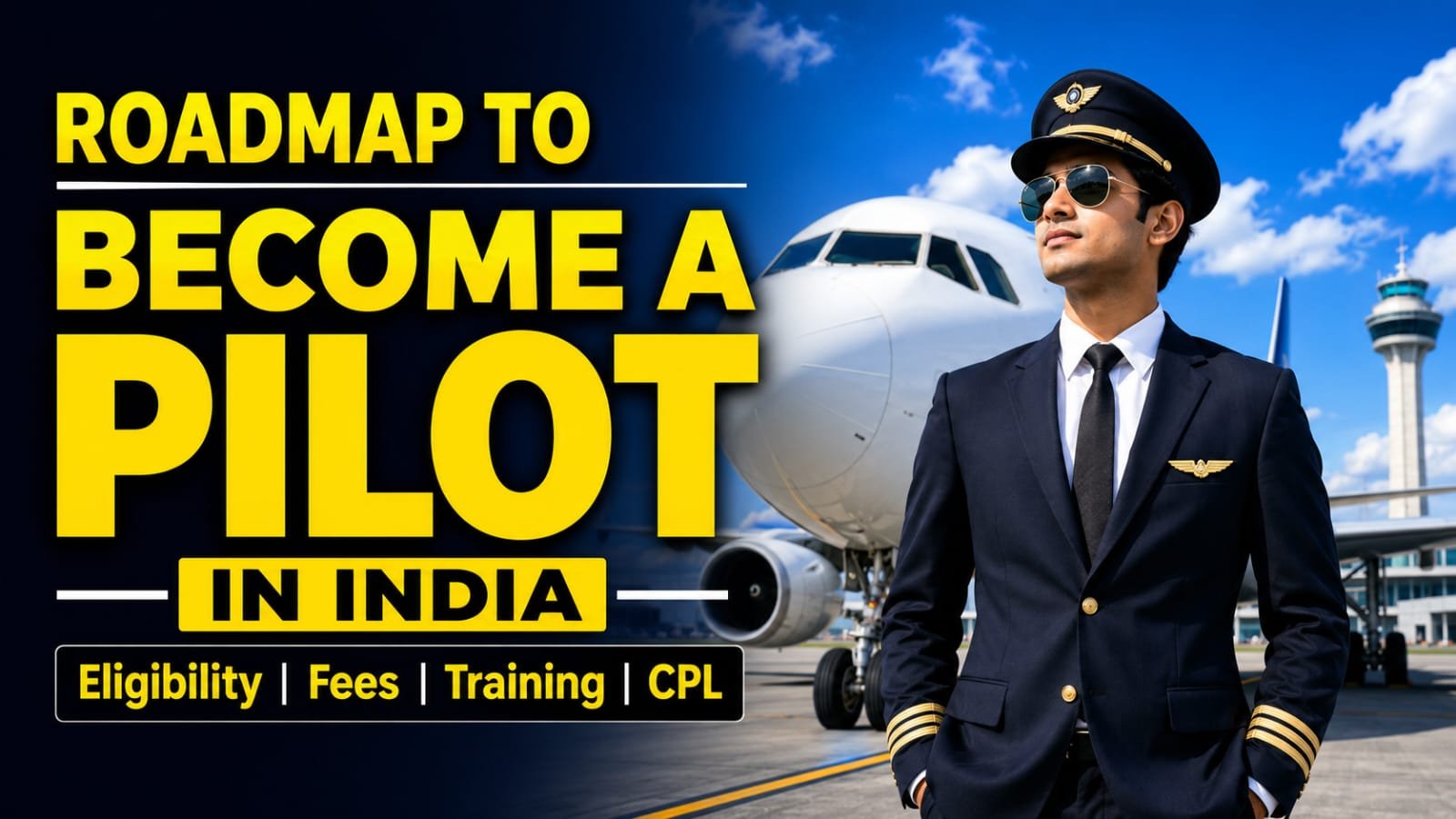
Becoming a pilot in India is a structured career journey that requires the right educational qualification, medical fitness, ground training, flight training, examinations and licensing. For students who dream of becoming commercial airline pilots, the Commercial Pilot Licence (CPL) is an important milestone in the professional pathway.
However, getting a CPL does not automatically guarantee an airline job. Candidates may need additional training, ratings, experience and employer-specific requirements before starting an airline career.
A simple roadmap is:
Class 12 with Physics and Mathematics → Medical Assessment → Pilot Training → Ground Training → Examinations → Flight Training → CPL → Additional Training/Experience → Pilot Job
This guide explains the complete roadmap for students and graduates in India.
What Does a Pilot Do?
A pilot is responsible for operating an aircraft safely and following aviation procedures throughout a flight.
Depending on the type of operation, a pilot may be responsible for:
- Aircraft operation
- Flight planning
- Navigation
- Communication with air traffic control
- Monitoring aircraft systems
- Weather assessment
- Following safety procedures
- Handling unexpected situations
- Coordinating with other crew members
- Maintaining required flight records
The exact responsibilities depend on the aircraft, employer and type of flying operation.
Types of Pilot Careers in India
There are several career paths available in aviation.
Airline Pilot
Airline pilots operate passenger or cargo aircraft for commercial airlines.
The typical airline career progression may involve becoming a first officer and eventually progressing to captain after meeting the required experience and other conditions.
Commercial Pilot
A commercial pilot can work in professional flying operations subject to the applicable licence, ratings, experience and employer requirements.
Flight Instructor
Experienced pilots with the appropriate qualifications can pursue careers as flight instructors and train new student pilots.
Charter Pilot
Charter pilots operate aircraft for charter companies and other non-scheduled aviation operations.
Corporate Pilot
Corporate pilots fly aircraft used by companies, business organisations or private operators.
Government and Specialised Aviation Roles
Pilots may also find opportunities in government organisations or specialised aviation operations when vacancies are available and the candidate meets the required qualifications.
Who Can Become a Pilot in India?
The eligibility requirements depend on the type of pilot licence and career path.
For students planning a professional flight crew career, the educational qualification, medical fitness, examination, training and licensing requirements are particularly important.
Candidates should generally have Physics and Mathematics at the required higher-secondary level for the professional pilot route.
The exact requirements should always be checked against the latest applicable aviation regulations before beginning training.
Educational Qualification to Become a Pilot
After Class 10
Students who want to become pilots should plan their Class 11 and Class 12 subjects carefully.
For the professional pilot pathway, Physics and Mathematics are important subjects.
Students can also begin developing:
- Mathematics skills
- Physics fundamentals
- English communication
- General awareness
- Computer skills
- Problem-solving ability
After Class 12
Candidates planning to pursue a professional pilot career generally need to meet the applicable higher-secondary educational requirements, including Physics and Mathematics.
A separate aviation degree is not necessarily required simply to obtain a professional pilot licence. Pilot training and licensing requirements are different from a conventional college degree.
However, some students choose to complete a degree alongside their aviation training for broader educational and career opportunities.
What If I Did Not Study Physics and Mathematics?
Students who did not study the required subjects should not immediately give up on their aviation plans.
The eligibility route depends on the applicable rules and accepted equivalent qualifications. Candidates should verify their individual eligibility before spending money on flight training.
Medical Fitness for Pilots
Medical fitness is one of the most important considerations when planning a professional pilot career.
A candidate may satisfy the educational requirements but still need to meet aviation medical standards.
For this reason, students should consider completing the appropriate medical assessment before making a major financial commitment to flight training.
This can help candidates understand whether they are medically suitable for their intended aviation career.
Roadmap to Become a Pilot in India
Step 1: Complete Class 12
Complete the required higher-secondary education with the subjects needed for the professional pilot pathway.
Students should develop a strong foundation in Physics and Mathematics.
Step 2: Understand Pilot Licensing Requirements
Before joining a flying school, learn about the current requirements for the licence you intend to obtain.
These can include:
- Educational qualifications
- Medical requirements
- Examinations
- Flight training
- Documentation
- Licensing procedures
Do not choose a flying school simply because it promises quick training or low fees.
Step 3: Complete the Required Medical Assessment
Medical assessment should be considered early in your planning.
This is particularly important because professional pilot training can involve a substantial financial investment.
Step 4: Register for Applicable Examinations
Candidates pursuing professional pilot licensing need to complete the relevant aviation examinations.
Understand the current examination process, syllabus and documentation requirements before beginning preparation.
Step 5: Choose a Suitable Flying Training Organisation
Selecting the right flight training organisation is one of the most important decisions in your pilot journey.
Compare factors such as:
- Regulatory approval
- Aircraft fleet
- Aircraft availability
- Instructor availability
- Training schedule
- Location
- Training environment
- Historical delays
- Total fees
- Additional charges
- Accommodation
- Student support
Do not select a school only because it advertises the lowest price.
Step 6: Complete Ground Training
Ground training develops the theoretical knowledge required for aviation examinations and flying.
Students may study areas such as:
- Air regulations
- Aviation navigation
- Meteorology
- Aircraft and technical subjects
- Communication procedures
- Flight planning
- Aviation safety
The exact subjects depend on the licence and applicable requirements.
Step 7: Pass the Required Examinations
Candidates must complete the examinations applicable to their intended licence.
Strong preparation is important because aviation examinations require an understanding of technical concepts rather than simple memorisation.
Step 8: Complete Flight Training
Flight training is where students develop practical flying skills under the supervision of qualified instructors.
Training may involve:
- Aircraft handling
- Take-offs
- Landings
- Circuit flying
- Solo flying
- Navigation
- Cross-country flying
- Instrument-related training
- Night flying where applicable
- Emergency procedures
The exact flight-training requirements depend on the licence and current regulations.
Step 9: Complete Licensing Requirements
After meeting the required educational, medical, examination and flight-training conditions, candidates can proceed with the applicable licensing process.
The requirements should be checked against the latest regulations because aviation rules and procedures can change.
Step 10: Build a Professional Pilot Career
Obtaining a CPL is an important achievement, but it is not necessarily the final step.
Depending on the career path, candidates may need:
- Additional ratings
- Aircraft-specific training
- Additional flying experience
- Employer-specific qualifications
- Selection or recruitment tests
A possible career progression is:
Student Pilot → CPL Holder → Entry-Level Flying Opportunity → First Officer → Experienced First Officer → Captain
The actual progression depends on the employer and type of aviation operation.
Courses and Qualifications for Becoming a Pilot
There is no single college course that automatically makes someone an airline pilot.
The professional pathway primarily involves meeting the applicable pilot licensing and training requirements.
| Qualification / Training | Purpose |
|---|---|
| Class 12 with required subjects | Provides the educational foundation |
| Ground Training | Develops aviation theory and technical knowledge |
| Flight Training | Develops practical flying skills |
| Commercial Pilot Licence | Important professional pilot qualification |
| Additional Ratings | Supports specific flying requirements |
| Aircraft-Specific Training | Prepares pilots for particular aircraft where required |
Students should distinguish between a degree and a pilot licence. They serve different purposes.
Skills Required to Become a Pilot
A successful pilot needs technical knowledge as well as strong personal and professional skills.
| Skill | Importance |
|---|---|
| Decision-making | Helps pilots respond appropriately to different situations |
| Communication | Essential for clear coordination |
| Concentration | Supports safe and accurate aircraft operation |
| Situational awareness | Helps pilots understand changing flight conditions |
| Technical knowledge | Required to understand aircraft and procedures |
| Discipline | Aviation requires strict adherence to procedures |
| Teamwork | Pilots work closely with crew and ground teams |
| Problem-solving | Useful when unexpected situations arise |
| Stress management | Helps maintain composure during demanding situations |
Pilot Training in India
Pilot training combines theoretical education with practical flight training.
Ground School
Students learn aviation theory and prepare for relevant examinations.
Flight Training
Students learn aircraft operation under the supervision of qualified instructors.
Solo Flying
After reaching the required level of competency, students may be permitted to undertake solo flights as part of their training.
Navigation Training
Students learn flight planning, route planning, navigation and related procedures.
Instrument Training
Students develop skills for operating using aircraft instruments and applicable procedures.
The exact training requirements depend on the licence and applicable regulations.
How Long Does It Take to Become a Pilot?
There is no single duration that applies to every student.
The total training period can depend on:
- Weather
- Aircraft availability
- Instructor availability
- Flying school
- Student performance
- Examination schedules
- Medical requirements
- Training interruptions
- Regulatory requirements
- Flying conditions
Therefore, students should be cautious about advertisements that promise exactly the same completion time for every candidate.
How Much Does Pilot Training Cost in India?
Pilot training can require a significant financial investment.
Expenses may include:
- Flight training
- Ground training
- Examination fees
- Medical examinations
- Licensing expenses
- Accommodation
- Food
- Travel
- Study materials
- Equipment
- Uniform
- Additional flying
- Repeat examinations
- Additional training
The final cost varies between training organisations and individual students.
Factors That Affect Pilot Training Cost
| Factor | Effect on Cost |
|---|---|
| Flying school | Fee structures differ |
| Aircraft | Operating costs can vary |
| Flying hours | Additional hours can increase expenses |
| Training delays | Can increase living and related expenses |
| Accommodation | Depends on location and facilities |
| Examination attempts | Additional attempts may create extra costs |
| Additional training | Can increase the total expenditure |
Before joining a flying school, request a detailed fee structure and ask which expenses are included and which are charged separately.
Can I Become a Pilot Without a Degree?
A separate bachelor’s degree is not necessarily the central requirement for the professional pilot licensing pathway.
The more important requirements are the applicable educational qualification, medical fitness, examinations, flight training and licensing requirements.
However, students may choose to complete a degree for additional educational and career options.
Can I Become a Pilot After Graduation?
Yes.
Graduates can pursue pilot training if they meet the applicable educational, medical and licensing requirements.
Being older than a typical Class 12 student does not automatically prevent someone from exploring pilot training, although candidates must consider the applicable age and licensing rules.
Can I Become a Pilot After 10th?
Students generally cannot complete the professional airline pilot pathway immediately after Class 10.
The professional route requires the applicable higher-secondary educational qualification.
However, Class 10 students can begin preparing by choosing appropriate subjects for Classes 11 and 12 and learning about aviation careers.
Can I Become a Pilot Without Physics and Mathematics?
For the professional pilot pathway, the required educational qualification includes Physics and Mathematics or an accepted equivalent route.
Candidates who did not study these subjects should verify the current eligibility requirements and any accepted alternatives before enrolling in flight training.
Can Girls Become Pilots in India?
Yes.
Women can pursue pilot careers in India if they meet the applicable educational, medical, examination, training and licensing requirements.
The decision should be based on individual interest, aptitude, career goals and financial planning.
Government Pilot Jobs in India
Government pilot opportunities may become available through different organisations and aviation operations.
Potential areas can include:
- Government aviation organisations
- Public-sector organisations
- Government departments
- Specialised aviation operations
- Defence-related aviation careers
- State-level aviation operations
The eligibility requirements vary considerably between organisations.
Candidates should always read the specific recruitment notification instead of assuming that all government pilot jobs have the same requirements.
Private Pilot Jobs in India
Private-sector pilot opportunities can include:
- Airlines
- Charter companies
- Corporate aviation
- Cargo operators
- Flight training organisations
- Specialised aviation operators
Airline recruitment can require qualifications beyond a CPL.
Employers may consider:
- Licence status
- Ratings
- Flight experience
- Medical fitness
- Examination requirements
- Aircraft-specific training
- Interview performance
- Communication skills
- Employer-specific eligibility
How to Get Your First Pilot Job
Getting your first professional flying position requires more than simply completing training.
Maintain Your Documents
Keep your:
- Licence information
- Medical documents
- Flight records
- Ratings
- Examination records
- Training certificates
- Resume
organised and updated.
Continue Learning
Keep revising technical knowledge and aviation procedures even after completing your initial training.
Prepare for Recruitment
If your goal is an airline career, learn about the recruitment process of the employers you are targeting.
Improve Communication
Clear communication is an important professional skill for pilots.
Be Prepared for Additional Training
Some employers may require additional training before a pilot begins operational flying.
Pilot Salary in India
Pilot salaries can vary considerably.
Factors affecting salary include:
- Employer
- Pilot rank
- Aircraft type
- Experience
- Flight hours
- Location
- Employment contract
- Allowances
- Seniority
An entry-level pilot and an experienced airline captain should not be expected to earn the same amount.
There is also no guaranteed salary simply because someone has obtained a CPL.
Candidates should therefore avoid relying on social media posts or advertisements that promise a fixed salary for every pilot.
Career Growth for Pilots
Pilot careers can develop with experience, qualifications and professional progression.
A broad airline career path can be:
CPL Holder → First Officer → Senior First Officer → Captain
Depending on experience and qualifications, pilots may also move into areas such as:
- Flight instruction
- Pilot training
- Safety-related roles
- Aviation operations
- Aviation management
- Other specialised aviation positions
Career progression depends on individual performance, experience, qualifications, employer requirements and available opportunities.
Advantages of Becoming a Pilot
Specialised Career
Piloting is a highly specialised professional career requiring technical knowledge and training.
Travel Opportunities
Depending on the employer and operation, pilots may travel to different cities and countries.
Continuous Professional Development
Pilots continue developing technical and operational skills throughout their careers.
Multiple Aviation Career Options
Experienced pilots can potentially move into training, instruction, management and other aviation-related areas.
Challenges of Becoming a Pilot
High Training Cost
Flight training can require substantial financial investment.
Medical Requirements
Maintaining the required medical fitness is important for a professional flying career.
Training Delays
Weather, aircraft availability and other operational factors can affect training schedules.
Competitive Employment
A pilot licence does not automatically guarantee an airline position.
Continuous Training
Pilots must maintain their knowledge, skills and required qualifications.
Irregular Working Hours
Professional pilots may work weekends, holidays and irregular schedules depending on their employer and flight operations.
Who Should Choose a Pilot Career?
A pilot career may suit someone who:
- Has a genuine interest in aviation
- Enjoys technical subjects
- Can remain focused for long periods
- Is comfortable following procedures
- Can make responsible decisions
- Communicates clearly
- Works well in a team
- Is willing to continue learning
- Has carefully considered the financial commitment
Students should not choose pilot training only because they expect a high salary or consider the profession glamorous.
Who May Not Prefer a Pilot Career?
Pilot training may be challenging for someone who:
- Dislikes technical subjects
- Does not like following strict procedures
- Does not want continuous training
- Is not prepared for the financial commitment
- Dislikes irregular working schedules
- Has not researched aviation medical requirements
- Is choosing the profession only because of salary expectations
Understanding the actual responsibilities and lifestyle of pilots is important before choosing this career.
Common Mistakes Students Make
Choosing a Flying School Only Because of Price
The cheapest school is not automatically the best school.
Ignoring Medical Requirements
Medical eligibility should be considered before making a major investment in training.
Believing Guaranteed Job Promises
Completing pilot training does not automatically guarantee employment with an airline.
Underestimating Total Expenses
Students should consider accommodation, additional flying, examinations and possible training delays.
Depending Only on Coaching
Understanding aviation concepts is more important than simply memorising examination answers.
Using Outdated Information
Aviation rules and procedures can change. Students should verify current requirements before making important decisions.
Roadmap to Become a Pilot After Class 12
The overall pathway can be summarised as:
Class 12 with Physics and Mathematics
↓
Check Medical Eligibility
↓
Understand Pilot Licensing Requirements
↓
Complete Applicable Registration and Examinations
↓
Choose a Suitable Flying Training Organisation
↓
Complete Ground Training
↓
Complete Flight Training
↓
Meet Licensing Requirements
↓
Obtain CPL
↓
Complete Additional Training or Requirements
↓
Apply for Suitable Pilot Opportunities
↓
Build Experience and Progress in Your Career
The exact sequence may differ depending on the licence and career path.
Career Options After Getting a CPL
A CPL can provide the foundation for several professional aviation careers, depending on the candidate’s ratings, experience and employer requirements.
| Career Option | General Work Area |
|---|---|
| Airline Pilot | Passenger or cargo airline operations |
| Charter Pilot | Charter and non-scheduled flying |
| Corporate Pilot | Business aviation |
| Flight Instructor | Pilot training |
| Commercial Aviation | Professional flying operations |
| Aviation Training | Training and instructional roles with appropriate qualifications |
| Aviation Management | Operational or management careers after gaining relevant experience |
A CPL should not be treated as an automatic airline appointment.
Frequently Asked Questions
1. What is the roadmap to become a pilot in India?
The general roadmap is to complete the required Class 12 education, meet medical requirements, complete pilot training and examinations, obtain the required licence and then pursue suitable professional flying opportunities.
2. What subjects are required to become a commercial pilot in India?
Students pursuing the professional pilot pathway generally need the required higher-secondary qualification with Physics and Mathematics or an accepted equivalent route.
3. Can I become a pilot after Class 12?
Yes. Students who meet the applicable educational, medical and licensing requirements can begin professional pilot training after Class 12.
4. Is a degree compulsory to become a commercial pilot?
A separate bachelor’s degree is not necessarily the central licensing requirement. Candidates must meet the applicable educational, medical, examination, training and licensing conditions.
5. Is medical fitness required to become a pilot?
Yes. Aviation medical fitness is an important requirement for professional pilots.
6. How much does pilot training cost in India?
The cost varies depending on the flying school, flight hours, aircraft, accommodation, additional training and other expenses. Students should obtain a detailed fee structure before enrolling.
7. How long does pilot training take?
There is no fixed duration for every candidate. Weather, aircraft availability, instructor availability, examinations and individual progress can affect the training period.
8. Can girls become pilots in India?
Yes. Women can pursue pilot careers if they meet the applicable educational, medical, training, examination and licensing requirements.
9. Can I become a pilot without Physics and Mathematics?
Candidates who do not have the required subjects should first verify the current eligibility requirements and accepted alternatives before enrolling in professional flight training.
10. Can a CPL holder directly become an airline captain?
No. Becoming a captain requires additional experience, training, qualifications and progression after entering professional aviation.
11. Are government pilot jobs available in India?
Government pilot opportunities can arise depending on recruitment. Eligibility varies by organisation and position.
12. Is a pilot job guaranteed after completing CPL training?
No. A CPL does not guarantee an airline job. Employment depends on vacancies, qualifications, experience, selection processes and employer requirements.
Post You Might Be Interested In:-
- India Post GDS Recruitment 2026: BPM, ABPM and Dak Sevak Eligibility, Salary, Selection and Apply Online
- How to Become a Journalist, Courses, Eligibility, Skills, Salary, Jobs and Career Guide
- Jewellery Designer in India | How to Become a Jewellery Designer, Courses, Eligibility, Skills, Salary, Jobs and Career Guide

- How to Become a Movie Director in India | Film Institutes In India Courses, Skills, Salary and Career Path