
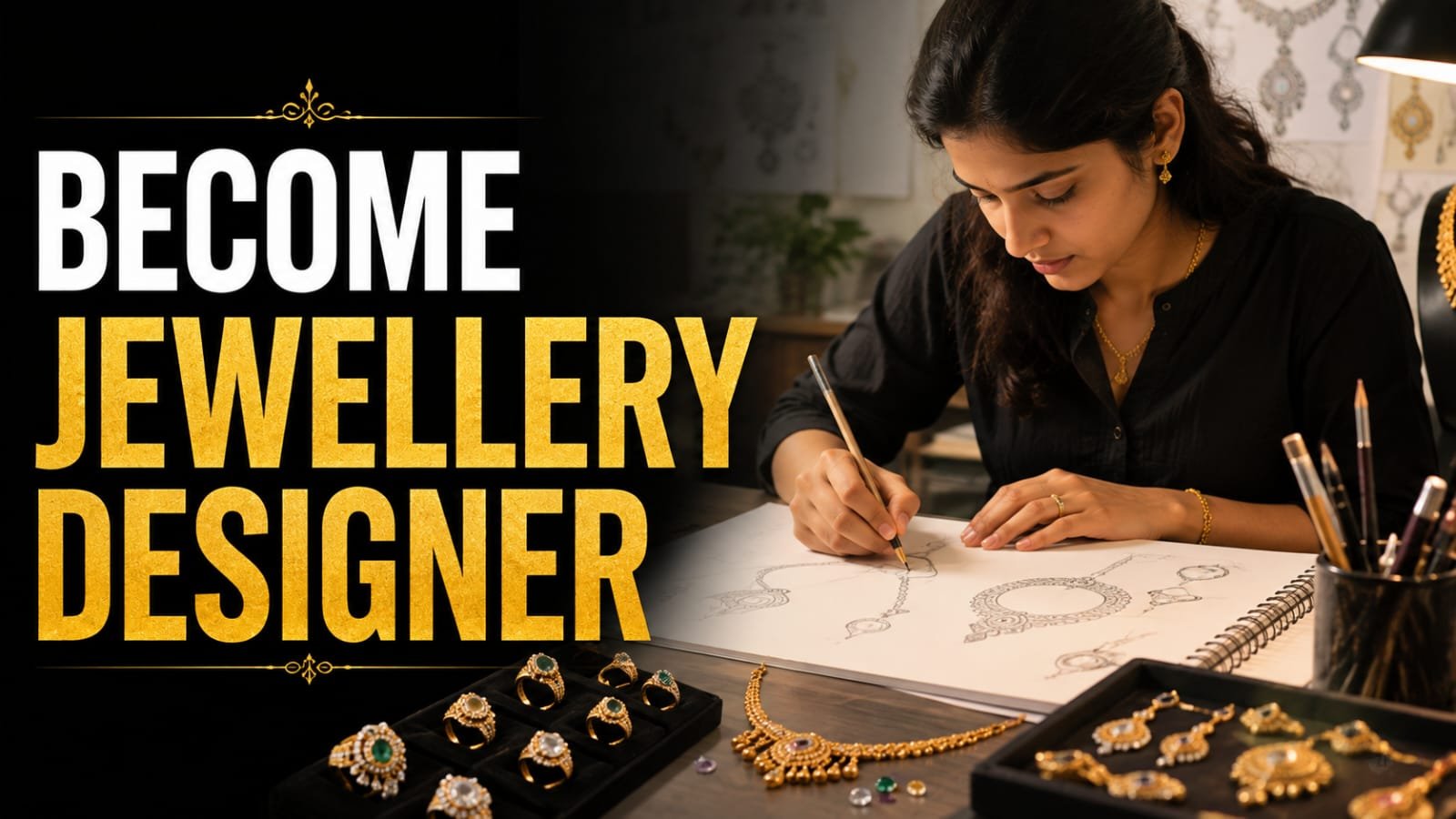
A jewellery designer creates designs for jewellery such as rings, necklaces, earrings, bracelets, bangles, pendants and other ornaments. The work combines creativity with knowledge of materials, gemstones, jewellery-making techniques and design principles.
Jewellery designing can be a suitable career for people who enjoy drawing, fashion, creativity, product design and working with details. A jewellery designer may work for a jewellery brand, manufacturing company, design studio or export business. Some professionals also work independently or start their own jewellery design business.
This guide explains what a jewellery designer does, how to become one in India, courses after 10th and 12th, education options, skills, internships, career opportunities, salary, work environment, advantages, challenges and the future of jewellery design.
What Is a Jewellery Designer?
A jewellery designer is a professional who develops the visual design and appearance of jewellery.
The designer may create an original concept or modify an existing design according to customer requirements, market trends or a company’s product plan.
A jewellery designer may work on:
- Rings
- Earrings
- Necklaces
- Pendants
- Bracelets
- Bangles
- Chains
- Brooches
- Bridal jewellery
- Fashion jewellery
- Gold jewellery
- Silver jewellery
- Diamond jewellery
- Gemstone jewellery
The designer needs to consider appearance as well as practical factors such as size, proportion, comfort, materials and manufacturing requirements.
What Does a Jewellery Designer Do?
The exact responsibilities depend on the organisation and type of jewellery being designed.
Creating Design Concepts
A designer develops ideas for new jewellery pieces.
The concept may be based on:
- Customer requirements
- Fashion trends
- Traditional designs
- Cultural influences
- Brand identity
- Seasonal collections
- Market demand
Drawing Jewellery Designs
Designers may create hand-drawn sketches or use computer software to develop detailed designs.
Selecting Materials
Depending on the project, the designer may work with:
- Gold
- Silver
- Platinum
- Diamonds
- Gemstones
- Pearls
- Other jewellery materials
The designer needs to understand how different materials affect the appearance and construction of the product.
Working With Manufacturers
A jewellery design must eventually be converted into a physical product.
Designers may communicate with craftsmen, CAD designers, manufacturers and production teams to make sure the design can be produced correctly.
Making Design Changes
A customer, company or production team may request modifications.
The designer may change:
- Shape
- Size
- Stone arrangement
- Pattern
- Weight
- Colour combination
- Surface details
Studying Trends
Jewellery designers need to understand changing customer preferences and fashion trends.
Creating Collections
Experienced designers may create complete jewellery collections rather than individual pieces.
For example, a designer may develop a collection around a particular theme, festival, wedding style or fashion trend.
Types of Jewellery Designers
Jewellery designing can have different specialisations.
Hand Sketch Jewellery Designer
These designers create jewellery concepts using traditional drawing and sketching techniques.
Strong drawing and observation skills are particularly useful.
CAD Jewellery Designer
CAD designers use computer software to create detailed three-dimensional jewellery models.
Computer-aided design is widely used in modern jewellery production.
Fashion Jewellery Designer
Fashion jewellery designers work on products designed around changing fashion trends and customer preferences.
Fine Jewellery Designer
Fine jewellery designers may work with precious metals and valuable gemstones.
Bridal Jewellery Designer
These designers focus on jewellery used for weddings and related occasions.
Custom Jewellery Designer
Custom designers create pieces according to individual customer requirements.
Jewellery Collection Designer
Experienced designers may develop an entire product collection with a consistent theme and visual identity.
Not every jewellery designer specialises in only one area. A professional may develop several skills over time.
How to Become a Jewellery Designer in India
There is no single compulsory route for every jewellery designer.
A common pathway is:
School Education → Jewellery Design Course → Design Skills → Practical Training → Portfolio → Internship/Work Experience → Entry-Level Job → Specialisation → Career Growth
A beginner can follow these steps:
- Complete the required school education.
- Choose a suitable jewellery or fashion design course.
- Learn drawing and design fundamentals.
- Learn about jewellery materials and gemstones.
- Learn computer-aided jewellery design if relevant.
- Practise creating jewellery concepts.
- Build a professional portfolio.
- Complete practical training or an internship.
- Apply for entry-level design positions.
- Gain experience in jewellery production and design.
- Develop a specialisation.
- Consider freelance work or starting a jewellery business after gaining sufficient experience.
The exact route depends on the person’s education, skills and career goals.
Can I Become a Jewellery Designer After 10th?
Yes, students can begin preparing for a career in jewellery design after Class 10.
Depending on the institution, students may find diploma, certificate or other design-related programmes that accept students after Class 10.
However, eligibility differs between institutions.
A student who wants to become a jewellery designer can also use this stage to develop basic skills such as:
- Drawing
- Sketching
- Colour understanding
- Design principles
- Computer skills
- Observation
- Creativity
Completing Class 12 can provide additional course options.
Can I Become a Jewellery Designer After 12th?
Yes.
After Class 12, students can consider undergraduate degree, diploma or other jewellery design programmes.
Possible study areas include:
- Jewellery Design
- Jewellery Design and Technology
- Fashion Design
- Accessory Design
- Product Design
- Fine Arts
- Other related design programmes
The exact course name and eligibility depend on the institution.
Students should choose a course that provides both design education and practical exposure.
Can I Become a Jewellery Designer After Graduation?
Yes.
Graduates can enter jewellery design through:
- Postgraduate design programmes
- Diploma courses
- Certificate programmes
- Specialised CAD training
- Gemstone-related training
- Practical industry experience
A graduate from another subject may also change careers by developing the required design and technical skills.
For example, someone with a background in fashion may move into jewellery design, while a person with a design background may specialise in jewellery CAD.
Educational Qualification for Jewellery Designing
There is no single educational qualification required for every jewellery designer position.
| Education Level | Possible Route | Purpose |
|---|---|---|
| Class 10 | Diploma or certificate where eligible | Begin basic design training |
| Class 12 | Degree, diploma or specialised course | Develop professional design skills |
| Graduation | Advanced design course or specialisation | Develop advanced knowledge |
| Any suitable qualification | CAD or specialised training | Build specific technical skills |
Some employers may focus more heavily on portfolio quality and practical skills, while others may prefer candidates with formal design education.
Jewellery Designing Courses
Diploma in Jewellery Design
A diploma can provide focused training in jewellery design.
Students may learn:
- Design fundamentals
- Jewellery sketching
- Materials
- Gemstones
- Jewellery construction
- Design development
- Basic production knowledge
Degree Programmes
Degree-level design education may provide broader training.
Depending on the programme, subjects may include:
- Design theory
- Drawing
- Product development
- Jewellery design
- Materials
- Manufacturing
- Computer-aided design
- Design history
- Portfolio development
Certificate Courses
Short-term courses can help beginners learn specific skills.
Examples include:
- Jewellery sketching
- CAD jewellery design
- Gemstone knowledge
- Jewellery rendering
- Computer-aided modelling
CAD Jewellery Design Courses
CAD training is particularly useful for people who want to work with digital jewellery modelling.
Students learn to create detailed jewellery models using specialised computer software.
The exact software used can vary between training institutes and employers.
Eligibility for Jewellery Design Courses
Eligibility depends on the course.
Possible requirements include:
- Class 10 qualification
- Class 12 qualification
- Graduation
- Minimum marks
- Entrance test
- Design aptitude test
- Portfolio
- Interview
Not every course has all these requirements.
Students should check the current admission requirements before applying.
Entrance Exams for Jewellery Design
An entrance examination is not compulsory for every jewellery design course.
Some design institutions may use:
- Design aptitude tests
- Entrance examinations
- Portfolio evaluation
- Interviews
- Merit-based admission
The selection method depends on the institution and programme.
Students should check the current admission process before applying.
Skills Required to Become a Jewellery Designer
Drawing Skills
Drawing is an important foundation for jewellery design.
A designer should be able to communicate the shape, proportion and details of a jewellery piece visually.
Creativity
Jewellery design requires the ability to develop new ideas and combinations.
Knowledge of Materials
Designers should understand the basic characteristics of metals, gemstones and other materials used in jewellery.
Colour Understanding
Understanding colour combinations can help when working with gemstones and different metals.
Observation
Small details can make a significant difference in jewellery design.
Knowledge of Jewellery Construction
A designer should understand how jewellery is manufactured.
A design may look attractive on paper but still need changes if it is difficult or impractical to produce.
CAD Skills
Computer-aided design skills can be valuable in modern jewellery production.
Communication Skills
Designers may need to explain their ideas to customers, craftsmen, CAD specialists and production teams.
Patience
Jewellery design involves detailed work, so patience and attention to detail are important.
Understanding of Trends
Designers should understand what customers are currently interested in while also developing their own design identity.
How to Develop Jewellery Design Skills
A beginner can develop skills through regular practice.
Try to:
- Draw jewellery every day.
- Study existing jewellery designs.
- Practise different styles.
- Learn basic design principles.
- Study gemstones and metals.
- Learn jewellery terminology.
- Practise hand rendering.
- Learn CAD software.
- Create sample designs.
- Visit jewellery exhibitions where possible.
- Study traditional Indian jewellery.
- Study contemporary jewellery.
- Build a portfolio.
The portfolio should show different types of work rather than many similar drawings.
Jewellery Design Portfolio
A portfolio is particularly important for a creative career.
A jewellery design portfolio can include:
- Hand sketches
- Finished jewellery illustrations
- CAD models
- Design concepts
- Collection themes
- Custom jewellery designs
- Material ideas
- Technical drawings
- Final product photographs where available
A strong portfolio should demonstrate both creativity and an understanding of practical jewellery design.
For students, portfolio development can begin during their course rather than waiting until graduation.
Internships and Practical Experience
Practical experience can help a student understand how jewellery moves from an idea to a finished product.
An internship may provide exposure to:
- Jewellery design
- CAD modelling
- Manufacturing
- Gemstone selection
- Production
- Quality checking
- Customer requirements
- Collection development
Working with experienced designers and craftsmen can also help beginners understand practical limitations that are difficult to learn from drawings alone.
How to Get the First Jewellery Design Job
Step 1: Complete Training
Choose a suitable jewellery design or related course.
Step 2: Develop Skills
Improve drawing, design, CAD and material knowledge.
Step 3: Create a Portfolio
Prepare a collection of your strongest work.
Step 4: Gain Practical Experience
Complete internships, workshops or practical projects.
Step 5: Apply for Entry-Level Roles
Look for suitable opportunities with jewellery brands, manufacturers, design studios and other businesses.
Step 6: Prepare for Interviews
Be ready to explain your designs and the thinking behind them.
Step 7: Continue Learning
Learn new software, techniques, materials and design approaches as your career develops.
Where Can a Jewellery Designer Work?
Jewellery designers can find opportunities in:
- Jewellery manufacturing companies
- Jewellery retail companies
- Jewellery brands
- Design studios
- Export houses
- Jewellery workshops
- Fashion accessory companies
- Custom jewellery businesses
- E-commerce jewellery businesses
- Independent design practices
Some professionals also work as freelancers.
Government Job Opportunities
Jewellery designing is primarily associated with private industry and independent work.
Government employment specifically titled “jewellery designer” is not as common as private-sector opportunities.
However, opportunities related to:
- Handicrafts
- Design education
- Artisan development
- Training
- Government-supported craft organisations
may be available depending on the organisation and recruitment requirements.
Candidates should check individual recruitment notifications rather than assuming that a jewellery design qualification automatically provides access to a particular government position.
Private Sector Opportunities
The private sector is the main employment area for jewellery designers.
Possible employers include:
- Jewellery manufacturers
- Jewellery brands
- Retail companies
- Export businesses
- Design studios
- Fashion accessory companies
- Custom jewellery businesses
Common roles may include:
- Junior Jewellery Designer
- Jewellery Designer
- CAD Jewellery Designer
- Jewellery Design Assistant
- Product Designer
- Collection Designer
- Custom Jewellery Designer
Job titles vary between companies.
Self-Employment and Jewellery Design Business
Experienced jewellery designers can consider independent work.
Possible options include:
- Freelance jewellery design
- Custom jewellery design
- Jewellery design consultancy
- Design services for manufacturers
- Online jewellery business
- Jewellery brand
- Jewellery collection development
Starting a jewellery business requires more than design skills.
A business owner may also need knowledge of:
- Pricing
- Materials
- Manufacturing
- Suppliers
- Customer service
- Marketing
- Inventory
- Finance
- Business regulations
Therefore, independent business can be a long-term option rather than an immediate requirement for beginners.
Jewellery Designer Salary in India
There is no single salary applicable to all jewellery designers.
Income can vary based on:
- Experience
- Skills
- Employer
- Location
- Qualification
- Portfolio
- CAD ability
- Specialisation
- Type of jewellery
- Organisation size
Entry-level designers generally earn less than experienced designers.
Professionals with strong design skills, technical knowledge, industry experience and a good portfolio may have better career opportunities.
Freelancers and business owners have a different income structure and may experience greater variation in earnings.
Students should be cautious about claims that guarantee a particular salary after completing a jewellery design course.
Career Growth in Jewellery Designing
A possible career path is:
Design Intern → Design Assistant → Junior Jewellery Designer → Jewellery Designer → Senior Jewellery Designer → Lead Designer/Design Head
Another path may involve CAD:
CAD Trainee → Junior CAD Designer → CAD Jewellery Designer → Senior CAD Designer → CAD/Design Specialist
Experienced professionals may eventually move into:
- Collection development
- Design management
- Creative direction
- Consulting
- Entrepreneurship
Career progression depends on experience, skill, portfolio and the organisation.
Work Environment
A jewellery designer may work in:
- Design studios
- Jewellery offices
- Manufacturing facilities
- Workshops
- Retail businesses
- Home studios
- Independent businesses
The work may involve long periods of drawing or computer work.
Depending on the position, designers may also visit:
- Manufacturing units
- Workshops
- Suppliers
- Jewellery exhibitions
- Client locations
Work can be highly detailed and may require concentration for extended periods.
Advantages of Jewellery Designing as a Career
Some potential advantages include:
- Creative work
- Opportunity to develop a personal design style
- Variety of jewellery products
- Scope for specialisation
- Opportunities in private industry
- Possibility of freelance work
- Possibility of entrepreneurship
- Opportunity to work with precious materials
- Potential to combine traditional and modern design
The actual benefits depend on the person’s career path.
Challenges and Disadvantages
Jewellery designing also has challenges.
High Attention to Detail
Small mistakes can affect the final product.
Competition
Creative industries can be competitive.
Need for Continuous Learning
Design trends, software and manufacturing methods change over time.
Production Limitations
A design may need modification because of manufacturing requirements or material limitations.
Customer Changes
Custom jewellery designers may need to revise designs several times based on customer feedback.
Computer-Based Work
CAD designers can spend many hours working at a computer.
Pressure to Create New Designs
Commercial designers may need to regularly develop new products that customers will want to buy.
Who Is Suitable for Jewellery Designing?
This career may suit someone who:
- Enjoys drawing
- Likes fashion and jewellery
- Has creative ideas
- Pays attention to small details
- Enjoys design work
- Is patient
- Is interested in materials and gemstones
- Likes working with computers
- Can accept design feedback
- Is willing to learn continuously
You do not have to be an expert artist when starting. Drawing and design skills can improve through practice.
Who May Not Be Suitable for Jewellery Designing?
Jewellery design may be difficult for someone who:
- Dislikes detailed work
- Has little interest in design
- Does not enjoy learning new software
- Is unwilling to practise
- Dislikes receiving design feedback
- Wants a career with completely predictable work
- Is not interested in understanding how products are manufactured
This does not mean such a person cannot work in the jewellery industry. Other roles may be more suitable.
Common Mistakes Beginners Make
Thinking Creativity Alone Is Enough
A professional designer also needs technical and practical knowledge.
Ignoring Manufacturing
A beautiful design still needs to be possible to manufacture.
Not Learning CAD
For many modern jewellery design roles, digital design skills can be valuable.
Creating a Weak Portfolio
A portfolio should show quality, variety and design thinking.
Copying Existing Designs
Studying existing jewellery can help learning, but professional designers should develop original work.
Ignoring Materials
Understanding metals and gemstones helps designers make practical decisions.
Choosing a Course Only Because It Is Cheap
Course quality, practical training and industry exposure should also be considered.
Expecting Immediate High Income
Career growth usually takes time.
How to Start Jewellery Designing From Zero
A complete beginner can follow this simple roadmap.
Stage 1: Learn Drawing
Start with basic shapes, proportions and jewellery sketches.
Stage 2: Study Jewellery
Observe traditional and modern jewellery and understand how different pieces are constructed.
Stage 3: Learn Design Principles
Study balance, proportion, symmetry, colour and composition.
Stage 4: Learn Materials
Understand the basic characteristics of metals and gemstones.
Stage 5: Learn CAD
Choose suitable jewellery CAD software and practise regularly.
Stage 6: Create Designs
Develop original jewellery concepts.
Stage 7: Build a Portfolio
Select your best work and present it professionally.
Stage 8: Gain Practical Experience
Look for internships, workshops or entry-level opportunities.
Stage 9: Get Industry Experience
Learn how designs are manufactured and sold.
Stage 10: Specialise
Choose an area such as bridal jewellery, CAD, fine jewellery, fashion jewellery or custom design.
Example Career Roadmap
One possible route is:
Class 10 → Class 12 → Jewellery Design Course → Drawing & CAD Skills → Portfolio → Internship → Junior Designer → Jewellery Designer → Senior Designer
Another route is:
Graduation in Another Subject → Jewellery Design Diploma → CAD Training → Portfolio → Internship → Entry-Level Job → Specialisation
These are examples only. Individual career paths can differ.
Cost of Becoming a Jewellery Designer
The cost depends on the course and institution.
Possible expenses include:
- Course fees
- Admission fees
- Drawing materials
- Design tools
- Computer or laptop
- CAD software or training
- Workshop expenses
- Books and learning materials
- Travel
- Portfolio development
Short-term courses can cost less than long-term degree programmes, while specialised professional training may have higher costs.
Students should compare course content, practical training, software exposure and industry opportunities before choosing a programme.
Is Jewellery Designing a Good Career in India?
Jewellery designing can be a good career for people who genuinely enjoy creative product design and are interested in the jewellery industry.
India has a long tradition of jewellery making, while modern jewellery businesses also use computer-aided design, contemporary styles and international markets.
However, the career is not automatically successful for everyone.
Before choosing jewellery design, ask yourself:
- Do I enjoy drawing and designing?
- Am I interested in jewellery and fashion?
- Do I enjoy detailed work?
- Am I willing to learn CAD?
- Can I accept feedback and make revisions?
- Am I interested in how products are manufactured?
- Am I willing to build a portfolio?
- Can I continue learning as trends change?
If the answers are mostly positive, jewellery designing may be worth considering.
Future of Jewellery Designing
Technology is changing jewellery design and production.
Important developments include:
- Computer-aided design
- 3D modelling
- 3D printing
- Digital rendering
- Computer-controlled manufacturing
- Online customisation
- E-commerce
- Artificial intelligence-assisted design tools
Technology can help designers create and modify concepts more quickly.
However, creativity, design judgement, understanding of jewellery construction and knowledge of customer preferences remain important.
Future jewellery designers may therefore benefit from combining traditional design knowledge with digital skills.
Related Career Options
If you are interested in jewellery but do not want to become a jewellery designer, consider related careers.
Jewellery CAD Designer
Focuses on creating detailed digital jewellery models.
Gemologist
Studies and evaluates gemstones.
Jewellery Manufacturer
Works with the production side of jewellery making.
Jewellery Merchandiser
Works with product selection, market trends and commercial planning.
Jewellery Sales Professional
Helps customers select jewellery and understand product features.
Fashion Accessories Designer
Designs accessories such as bags, belts, watches or other fashion products.
Product Designer
Creates designs for different types of consumer products.
Jewellery Design Institutes and Courses in India
| Institute | Jewellery Design Course | Official Link |
|---|---|---|
| JD Institute of Fashion Technology | B.Sc. Jewellery Design, Diploma in Fine Jewellery Design, CAD Jewellery Design and certificate courses | View Official Courses |
| National Institute of Jewellery Design (NIJD) | Jewellery Design and related training programmes | View Official Website |
| National Institute of Design (NID) | Design programmes with opportunities in related design domains | View Official Programmes |
Frequently Asked Questions
1. How can I become a jewellery designer after 12th?
You can pursue a jewellery design, accessory design or related programme and develop drawing, design, material and CAD skills.
2. Can I become a jewellery designer after 10th?
Yes, some diploma or certificate programmes may accept students after Class 10. Eligibility depends on the institution.
3. Is a degree compulsory to become a jewellery designer?
Not necessarily for every position. Some employers may focus heavily on skills, portfolio and practical experience.
4. What qualification is needed for jewellery designing?
Requirements vary. Students can enter through diploma, degree, certificate or specialised training depending on the programme.
5. Is CAD important for jewellery designers?
CAD can be an important skill, particularly for designers working in modern jewellery manufacturing and digital modelling.
6. What software is used by jewellery designers?
Different companies and designers use different software. The software requirement depends on the role and employer.
7. What skills are needed for jewellery designing?
Important skills include drawing, creativity, observation, material knowledge, jewellery construction, CAD, communication and attention to detail.
8. What is the salary of a jewellery designer in India?
Salary varies according to experience, skills, employer, location, specialisation and other factors. There is no single salary applicable to every jewellery designer.
9. Can I work from home as a jewellery designer?
Some design and freelance work can be performed from home, particularly digital CAD work. However, jobs involving manufacturing or workshops may require physical presence.
10. Can jewellery designers work independently?
Yes. Experienced designers can provide freelance services, create custom designs or start their own jewellery business.
11. Do jewellery designers need to know gemstones?
Basic knowledge of gemstones can be useful, particularly for designers working with fine jewellery.
12. Is drawing compulsory for jewellery designing?
Drawing is an important skill, but digital design tools can also be used. Developing both hand-sketching and digital skills can be useful.
13. Is jewellery designing a good career for women?
Jewellery designing is a career open to people of all genders. Career suitability depends on individual interests, skills and goals.
14. Can a fashion designer become a jewellery designer?
Yes. A fashion design background can provide useful knowledge of colour, trends and aesthetics. Additional jewellery-specific training may still be helpful.
15. Can jewellery designing be a business?
Yes. Experienced designers can start custom jewellery businesses, design studios or jewellery brands, but business knowledge and financial planning are also important.
Final Thoughts
Jewellery designing combines creativity, technical knowledge and an understanding of how jewellery is made and used. A professional designer may begin with a simple sketch and eventually turn the concept into a finished piece.
Students can start preparing after Class 10 or pursue specialised education after Class 12. Graduates from other fields can also enter the profession through suitable training.
The most important skills include drawing, creativity, attention to detail, knowledge of jewellery materials, understanding of manufacturing and computer-aided design.
A strong portfolio and practical experience can be especially valuable when looking for the first job.
Jewellery designing can offer opportunities in jewellery companies, manufacturing businesses, design studios, export businesses and independent work. At the same time, beginners should be prepared for competition, continuous learning and the need to develop practical skills.
If jewellery, design and creativity genuinely interest you, start small, practise regularly, learn both traditional and digital design methods, and gradually build a professional portfolio.
Post You Might Be Interested In:-
- MCL Recruitment 2026 – 500 Assistant Foreman and Technician Posts, Eligibility, Salary, Selection Process and Apply Online

- Group 2 Jobs in Telangana | Complete Preparation Guide – Syllabus – Study Plan and Exam Strategy

- Kurnool District Divyang Backlog Jobs 2026 – 38 Vacancies, Eligibility, Posts and Apply Details
- Telangana Group 4 Jobs 2026 | Complete Preparation Guide, Posts, Eligibility, Exam Pattern, Study Plan and Tips

- Stree Nidhi Recruitment 2026 – 10 Vacancies, Eligibility, Salary, Selection Process and Apply Online

- TG TET 2026 Complete Preparation Guide