
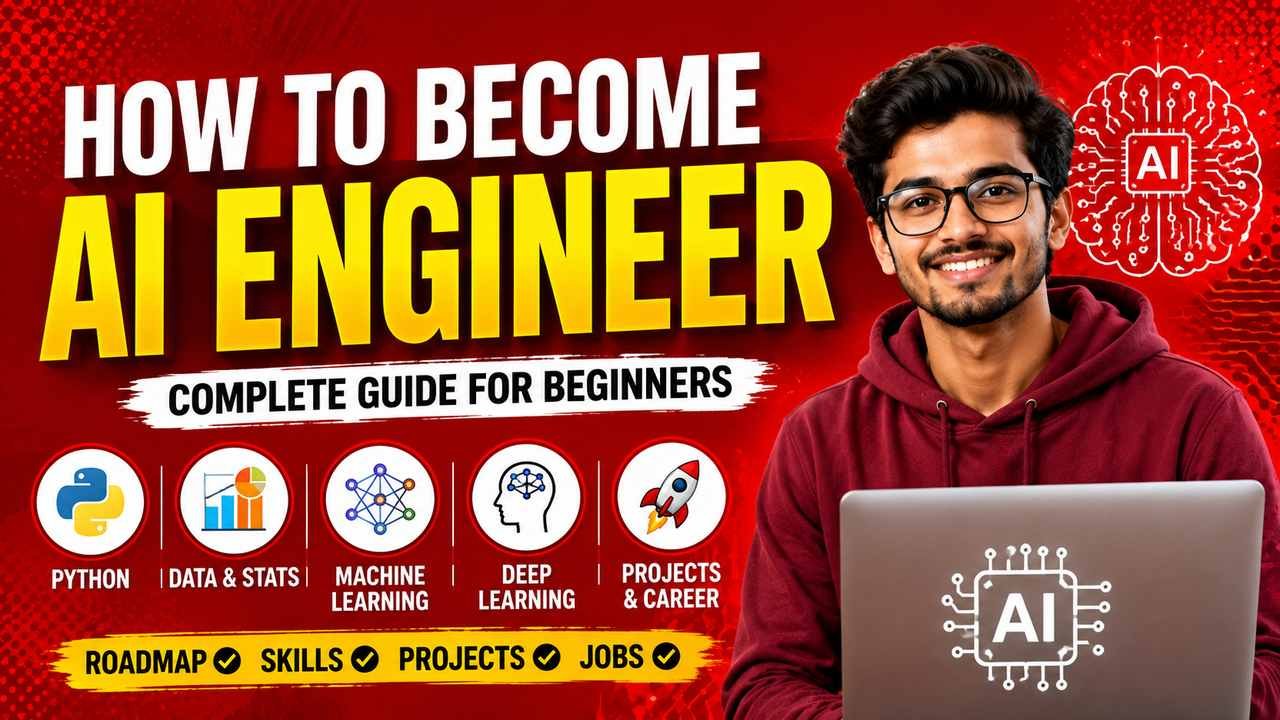
Artificial Intelligence (AI) is becoming an essential component of modern technology. AI is the backbone of chatbots, recommendation systems, image recognition applications, voice assistants, business software, and much more.
So, it is a perfect time to become an AI engineer, given the huge demand for professionals in this field.
If you are wondering how to become an AI engineer, then this guide is for you. You can start learning AI and machine learning basics to become an AI engineer.
In this article, we will discuss the AI engineer roadmap, education, programming languages, skills, projects, and much more. Let’s get started.

What Is An AI Engineer?
An AI engineer is a professional who designs computer systems and develops computer software that makes use of artificial intelligence. In other words, an AI engineer is a person who creates computer programs that enable a computer to perform functions that usually require human intellect.
An AI engineer typically works with chatbots, machine learning, and systems like recommendation systems, image recognition, speech recognition, predictive models, AI chatbots, generative AI models, websites and applications that make use of AI, and business automation, among others.
Therefore, the tasks of an AI engineer may vary depending on the company and the problem being solved using artificial intelligence.
What Does An AI Engineer Do?
The responsibilities of an AI engineer change depending on the company and the domain the engineer works in. However, as an AI engineer, there are some typical tasks that one undertakes. The tasks typically performed by AI engineers include:
1. Building AI Models
An AI engineer typically builds ML models to solve specific problems in a business. For instance, a company may hire you to build an ML model that can predict the likelihood of a business user stopping using their products.
2. Working With Data
An AI model typically requires data to be successful. Therefore, an AI engineer typically collects, and prepares the data sets needed to train the ML models. The process usually requires analyzing the data to determine the type of model that is suitable for a given data set.
3. Testing AI Systems
After developing an AI model, an AI engineer typically tests the model to ensure that it performs as expected. Therefore, you need to test your AI system to confirm that it meets the desired performance expectations.
4. Adding AI To Apps
The fourth step in the AI engineering process is adding the AI model to the application or target website. In other words, you need to deploy the model as an API and connect it to the relevant databases, applications, and websites.
How To Become An AI Engineer
You can become an AI engineer by following the steps discussed below:
1. Learn Mathematics
You don’t need to be a mathematical genius to become an AI engineer. However, you need a good understanding of Algebra, functions, graphs, probability, statistics, Linear Algebra, and Calculus. Statistics is a must when it comes to understanding how a machine learning model works.
It is advisable to start learning math alongside programming to become an AI engineer. So, start learning computer science, programming languages, and mathematics together.
2. Learn Python
Python is among the programming languages typically used in AI and machine learning. Therefore, you need to learn how to program in python. Some of the concepts you need to master in python programming include variables, data types, operators, conditional statements, loops, functions, classes, file handling, and exception handling.
However, at this point, avoid watching too many python tutorials. It is important to actually practice python coding. At this point, you can start building simple python applications such as finding the average of a number, finding the largest number in a list, removing, adding, and modifying list elements, reading and writing files using python, and so on.
The more you practice coding, the better you become.
3. Learn Data Structures And Algorithms
The next step is to learn data structures and algorithms. You need to start by learning computer science basics such as arrays and linked lists, Stacks and Queues, hash tables, sorting and searching, recursion, and algorithmic complexity.
It is important to have a good understanding of data structures and algorithms. At this point, you should not aim to be the best but rather be good at data structures and algorithms. Having good knowledge of algorithms and data structures helps you become a better problem solver.
4. Learn NumPy And Pandas
As an AI engineer, you will spend a lot of time working with data sets. Therefore, you need to learn how to use python libraries such as numpy and pandas to perform data analysis. Numpy helps you perform mathematical operations using python arrays while pandas helps you analyze CSV data sets.
Therefore, it is important to learn how to use pandas and numpy to load, filter, sort, delete, and manipulate CSV data sets. At this point, it is important to put your coding skills to test. So, you need to start writing real-world python programs.
5. Learn Data Visualization
Before you start building an AI model, it is important to carry out some data visualization to determine the patterns in the data set. That way, you can easily build a successful AI model. Therefore, you need to master how to carry out data visualization using python libraries such as matplotlib and seaborn.
At this point, it is important to learn how to plot bar graphs, line graphs, histograms, and scatter plots using python. This way, you can easily visualize the data sets.
6. Learn Machine Learning
Machine learning is another important aspect that you need to master when it comes to AI engineering. Using ML, you can create computer models that can learn on their own and carry out specific tasks like making predictions and decisions. Using ML, you can enable computers to think like humans.
The process of building an ML model is usually through training. In other words, you can train the model using a given data set. The trained ML model can then be used to make predictions and decisions.
There are two main types of ML: supervised and unsupervised ML.
Supervised ML
In supervised ML, you will be required to train an ML model using a labeled data set. In other words, supervised ML involves providing the computer with input-output data sets. The computer then tries to use the input data to predict the output. Some of the ML algorithms used in supervised ML include linear regression, logistic regression, decision trees, random forests, KNN, and SVM, among others.
Unsupervised ML
On the other hand, unsupervised ML involves training ML models using an unlabeled data set. Some of the ML algorithms used in unsupervised ML include K-means clustering, PCA, and Apriori.
7. Learn Deep Learning
The next step is to learn deep learning. Deep learning is a subset of ML that enables computers to carry out tasks like humans. Some of the major concepts used in deep learning include Neural Networks, activation functions, loss functions, back-propagation, optimization, CNNs, RNNs, and Transformers.
At this point, you need to start practicing deep learning using either PyTorch or TensorFlow. It is advisable to stick with one framework and master it instead of learning all the frameworks.
8. Learn Generative AI
Generative AI is a relatively new concept, and that is why most AI engineer roadmaps do not involve it. However, generative AI is becoming more important in AI engineering. Using generative AI, you can build chatbots, text generators, image generators, voice cloners, and video generators.
Some of the major concepts used in generative AI include large language models, tokens, embeddings, Transformers, vector databases, retrieval augmented generation, fine-tuning, agents, and model APIs. You should never attempt to develop a large language model on your own. Instead, you can use existing large language models like Llama to develop your applications.
9. Learn SQL
As an AI engineer, you will be required to work with databases almost all the time. Therefore, it is important to have a good working knowledge of Structured Query Language (SQL). You need to start by learning how to write basic SQL queries.
Some of the basic SQL queries include SELECT, WHERE, ORDER BY, GROUP BY, JOIN queries, COUNT, SUM, AVG, and subqueries, among others.
10. Learn Git And GitHub
Git is a version-control system that enables developers to track the changes made to a file or a set of files. On the other hand, GitHub is a hosting service for git repositories. Therefore, it is important to learn how to use git and GitHub to store your code online. Some of the concepts you need to master when it comes to GitHub include repositories, commits, branches, and documentation.
Having a good GitHub portfolio will give you an advantage when looking for jobs as an AI engineer.
An AI Engineer Roadmap For Beginners
The roadmap below shows the major skills you need to develop as you prepare to become an AI engineer.
Basic Math
Python Fundamentals
Data Structures
NumPy & Pandas
Statistics
Machine Learning
Deep Learning
Generative AI
Databases
Git & GitHub
Deployment
Real Projects
Internship / First Job
The roadmap shows the major skills needed to become an AI engineer. However, it is best to consult the roadmap and use it as a guide. Everyone has unique needs and different capabilities.
Do You Need A Degree To Become An AI Engineer?
Many employers usually require job applicants to have a degree in computer science, IT, or AI. However, you do not need a degree to become an AI engineer. The requirements may vary depending on the employer. Therefore, it is important to carry out your research to determine the hiring requirements of a particular organization.
Some of the degrees you can consider include computer science, information technology, artificial intelligence, data science, mathematics, statistics, and engineering.
Can A Non-Computer Science Student Become An AI Engineer?
Anyone can become an AI engineer regardless of their academic background. However, you need to have a good understanding of computer fundamentals, python programming, math, data analysis, and machine learning.
The best thing to do if you are not familiar with computer science fundamentals is to start by learning computer science and python programming.
Once you have mastered computer science and python programming, you can proceed to learn data analysis and machine learning.
Best AI Projects For Beginners
Projects are some of the best ways to master the concepts of AI engineering. You need to start by carrying out small projects and then move on to more complex projects as you gain more skills.
Some of the best beginner-friendly AI projects include:
• Creating a house price prediction model
• Building an email spam classifier
• Developing a movie recommendation system
• Developing a student performance prediction model
• Creating a customer churn prediction model
• Building an AI chatbot
• Designing a document question-answering system

How To Build An AI Portfolio
A portfolio is one of the most important things when looking for a job as an AI engineer. Therefore, you should always strive to have an impressive portfolio. However, when adding your projects to your portfolio, make sure you understand the following:
- What you were trying to achieve with the project
- The data set
- The technology used
- Project explanation
- Testing and model performance
- Challenges faced
- What you would have done differently
Once you understand these aspects, it will become easy to come up with project descriptions for your portfolio.
Once you have mastered all the concepts needed to become an AI engineer, you can start uploading your projects to your github repository and add them to your portfolio. That way, anyone reviewing your portfolio will be able to understand your projects.
How Long Does It Take To Become An AI Engineer?
The amount of time it takes to become an AI engineer varies depending on the time you are willing to spend learning. For instance, if you already know how to code in python, you can become an AI engineer within a year.
The table below shows the approximate time it takes to learn the various concepts required to become an AI engineer.
| Skill | Estimated Time |
|---|---|
| Python | 1-2 months |
| Mathematics & Stats | 1-2 months |
| Data Analysis | 1-2 months |
| Machine Learning | 2-3 months |
| Deep Learning | 2-3 months |
| Generative AI | 1-2 months |
| Projects & Deployment | 2-3 months |
These are just the approximate time it takes to learn the various concepts. The actual time may vary depending on your capabilities and other factors.
AI Engineer Skills To Learn
An AI engineer should have a combination of technical and soft skills. The best way to start is by mastering the basics discussed in this guide.
Below is a list of skills that are crucial for AI engineers:
Technical skills
• Python
• SQL
• Mathematics
• Statistics
• Machine learning
• Deep learning
• Generative AI
• Data analysis
• APIs
• Git
• Cloud basics
• Deployment
Soft Skills
• Problem-solving skills
• Communication
• Logical reasoning
• Teamwork
• Time management
• Learning ability
How To Get Your First AI Job
You can start looking for your first AI job, after mastering the basics of AI engineering. You should consider looking for any of the following positions:
• AI internships
• Machine learning internships
• Data science internships
• Junior AI engineer jobs
• Python development jobs
• Machine learning jobs
• Data analyst jobs
Your first job may not state AI engineer, but it will give you the much-needed experience to become an AI engineer.
How To Prepare For An AI Engineer Interview
To prepare for an AI engineer interview, you need to make sure you have a good understanding of the following:
Python
Make sure you have a good grasp of the python programming language. You should also be good at writing simple python programs. The following python concepts are usually tested during an AI engineer interview:
• Syntax and built-in functions
• String manipulation
• Conditional logic and loops
Data Structures
Make sure you have a good command of the following data structure concepts:
• Stacks, queues, and linked lists
• Trees, graphs, and heaps
• Hash tables
• Binary search
Machine Learning
Make sure you understand how a machine learning model works. The following topics are usually covered in an AI engineer interview:
• Training and test sets
• Classification
• Regression
• Model evaluation
• Overfitting and underfitting
Statistics
Make sure you have a good command of the following statistical concepts:
• Mean and median
• Probability
• Variance and standard deviation
Your Projects
It is important to make sure you understand your projects. You should go through all the projects listed in your portfolio.
Some of the questions you may face regarding your projects include:
• What made you choose one machine learning model over the other?
• How did you clean the data set?
• What challenges did you encounter when working on this project?
• How did you test your model?
• What would you have done differently?
Never include a project in your portfolio if you do not fully understand.
Common Mistakes To Avoid As A Beginner
Some of the common mistakes that beginner AI engineers often make include:
Trying To Learn Everything
AI engineering has a wide range of topics. However, as a beginner, it is important to focus on the essentials first before moving on to other advanced concepts.
Only Watching Tutorials
As a beginner, it is normal to watch many tutorials when learning AI engineering. However, you should avoid only watching tutorials. It is important to put your coding skills into practice.
Collecting Too Many Certifications
Having certifications is important, but it is best to avoid spending too much time searching for and collecting certificates.
Not Building Projects
Projects are one of the best ways to master the concepts of AI engineering. Therefore, it is important to make sure you always include building projects in your learning process.
Starting With Advanced AI
As a beginner, you should avoid advanced AI engineering concepts and start with the basics. For instance, if you do not know how to code, the best place to start is by learning how to code in python.
Ignoring Mathematics
Mathematics is not as hard as it seems. As an AI engineer, you do not need to be exceptionally good at math. However, you need a good working knowledge of fundamental math concepts.
Simple Daily Study Plan
Below is a sample study plan for people who have 3 hours daily to study AI engineering:
| Time | Activity |
|---|---|
| 45 minutes | Python & programming |
| 30 minutes | Mathematics |
| 30 minutes | Machine learning |
| 30 minutes | Project work |
| 30 minutes | Revision & practice |
If you have extra time, you can use it to do more project work. This way, you will have plenty of projects in your portfolio.
Final Tips To Become An AI Engineer
The following tips will help you become an AI engineer:
• Learn Python
• Develop your mathematical skills
• Practice coding
• Learn machine learning
• Build projects
• Learn how to work with real-world data sets
• Learn SQL
• Learn Git
• Learn modern generative AI
• Learn how to deploy applications
• Create a GitHub portfolio
• Apply for internships and entry-level jobs
• Keep learning new AI engineering skills
Conclusion
Becoming an AI engineer can be fun and exciting, especially if you have the right mindset. Anyone can become an AI engineer as long as they are determined to learn.
The first step towards becoming an AI engineer is by learning the basics of python programming language, math, and problem-solving concepts. After mastering the basics of AI engineering, you can proceed to learn data analysis, machine learning, and deep learning.
From there, you can go ahead and master more advanced concepts such as generative AI, deploying applications, and working with real-world data sets.
Finally, when learning AI engineering, it is important to always build projects to test your skills.
Posts You Might Be Interested :
- India Post GDS Recruitment 2026: BPM, ABPM and Dak Sevak Eligibility, Salary, Selection and Apply Online
- How to Become a Journalist, Courses, Eligibility, Skills, Salary, Jobs and Career Guide
- Jewellery Designer in India | How to Become a Jewellery Designer, Courses, Eligibility, Skills, Salary, Jobs and Career Guide
- How to Become a Movie Director in India | Film Institutes In India Courses, Skills, Salary and Career Path
- Can I Study MBBS Abroad Without NEET | Countries, Eligibility, Fees and Admission Guide